Happy (?) accidents
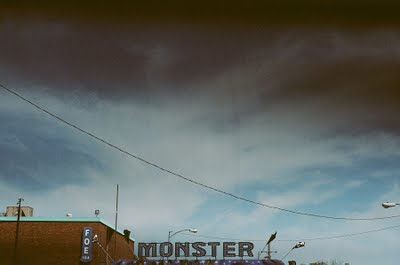
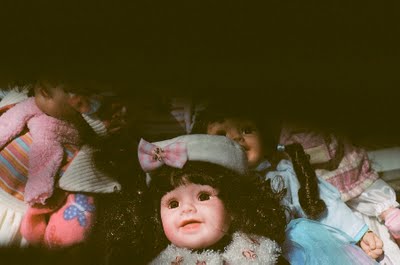
The aforementioned shutter problems lead to some interesting results. While I like the spontaneity of some of the mistakes, as illustrated above, I'm sending the camera in for repairs. I think I would get more and more frustrated as I saw more otherwise good photographs ruined.
South O

It took a little longer than I had expected, but the first two rolls of film of images from South Omaha are back from a photo lab in Texas. The good news is that the ol' Minolta works well for the most part, although the shutter appears to lag occasionally. Working from film scans will take some getting used to, but I like the results thus far.
For now, enjoy a few images from Sunday afternoon, May 8th.


ninety-three
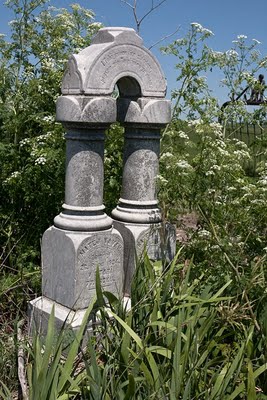
Matej Vavak came to Nebraska in 1868 with his wife and five children, settling on a homestead in the hills of Saunders County near what would become the Czech village of Prague. The family first built a log cabin, then a house, and farmed the land for many years. Upon his death, Matej was buried with his wife in a small cemetery in the fields of the property, marked with a large stone carved in his native Bohemian language.
I didn’t come to Nebraska until 1995, the summer before my junior year of high school. My father grew up in Prague and my mother in east-central Iowa, but I was born in Indiana after they were married. By the time I became interested in art and photography, I had lived in Nebraska for roughly half of my life, much longer than my family had stayed in any one place while I was growing up. I realized that I only knew a very small portion of the state I called home and decided to embark on a photo project designed to change that.
On a warm June day in 2007, I began my exploration at the grave of Matej Vavak, still standing in the midst of a field of newly planted soy beans. It seemed like a fitting place to begin the journey. That first day, I crossed the Platte River at North Bend and drove US Highway 30 west to Grand Island.
ninety-three developed over the course of a few road trips to every corner of the state. At first, I didn't really know exactly what it was I was looking for. This was the best possible way I could have approached something like this. Without a concrete plan, I was able to let Nebraska dictate how the project would look and influence the way my photography was developing. I found out a lot about myself in the landscape, from the isolation of a single lane of asphalt through the sandhills to the tremendous sound of a short grass prairie moving in the wind. Even though the project is now finished, I find myself with a strong need to revisit these places, to continue exploring Nebraska.
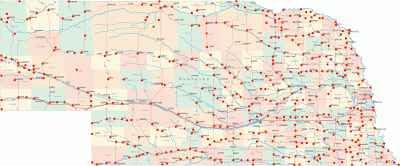
In the end, the series consists of one photograph for every one of the state’s 93 counties. It’s an unusual portrait of the state I call home, a visual document recording all the details that I encountered along the way. I hope that people enjoy the photographs and find themselves inspired to get to know Nebraska a little better.
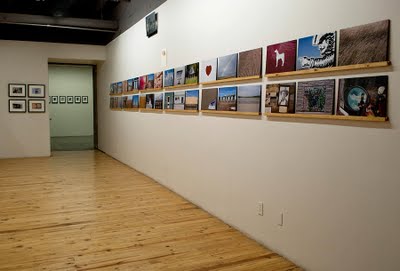
Selections from ninety-three were exhibited at Hot Shops Art Center in Omaha during May of 2010. I hope to show the entire series at some point and publish a book of the photographs.
Selections from ninety-three were exhibited at Hot Shops Art Center in Omaha during May of 2010. I hope to show the entire series at some point and publish a book of the photographs.
A new beginning...
It was almost a year ago that I found myself happily unemployed and toyed with creating a document of the South Omaha I had come to love since moving to this part of town. After a somewhat feeble attempt at starting the project, I put it on the back burner and continued to put a bit of polish on ninety-three instead. Today, I spent the afternoon photographing South Omaha once again, restarting what I hope will hold my attention and bring inspiration to me.
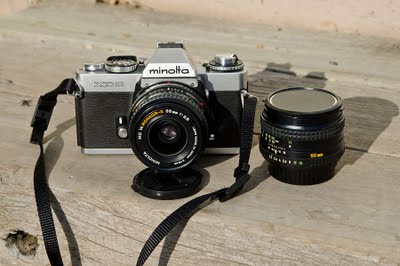
I have decided to shoot color film for the first time in a few years. Pictured above is the Minolta XD-5 SLR that I purchased a few weeks ago along with 35mm and 50mm lenses. It was manufactured in 1979, the same year I was born. The hope is that the older camera will seem less conspicuous than an all black, modern DSLR and people will be a little more comfortable around it.
As I worked with the Minolta today, I remembered why I like these simple manual focus cameras so much. The viewfinder is tremendous, the subject snaps in and out of focus smoothly as I turn the lens' focusing ring. It's a bit like driving a car with a manual transmission. The operator feels more connected with the machine, more involved in the process of taking a photograph. The XD-5 doesn't have all the bells and whistles, but it feels solid and the lenses are wonderfully small and well-built.
After shooting with digital for so long, I found returning to film to be a bit of an adjustment. There's no confirmation as to whether you got everything right or if something went horribly wrong. Thirty-six exposures seems both small and large at the same time. The last frame can come up right in the middle of a burst of creativity. Or it waits off in the distance, taunting you to find enough potential subjects to finish the roll. I can't decide what is worse, wasting the last few frames or leaving a half-shot roll in the camera, anxious to see what magic you captured, unable to develop the film until it reaches its end.
Cross your fingers for me. I'll (hopefully) have some images later this week, thirty-year old camera permitting.
For the photo nerds in the audience who care about such things, I'm trying out Kodak's Ektar 100 film. It's supposed to be as close to transparency film as print film gets, with the least grain of any color film. This is actually the first time I've ever shot Kodak color film. All of my older projects were shot with the now defunct Fujifilm NPS 160 film.